
Chapter Five: Beyond Bruises, One Year Later
Reclaiming my life after AI-enabled coercive control

A year can be a strange measurement after violence.
It is long enough for court dates to multiply, for paperwork to replace panic, for the bruises to fade…and for people to assume the worst must be over. It is also short enough that my body still remembers rooms, roads, certain smells, familiar voices, and the exact texture of fear.
One year ago, I was still trying to survive the end of a coercively controlling relationship that had forced AI, surveillance tools, physical violence, and narrative control into my everyday life. Now, I am preparing to teach professionals how to recognize that kind of system before another survivor is forced to explain it alone.
This time last year, I was not thinking about conferences or contributor agreements or professional language for AI-enabled coercive control. I was thinking about survival. I was thinking about my son. I was thinking about how to keep my mind intact long enough to explain what had happened to me.
Now I am preparing to stand in front of domestic violence professionals and say out loud what I once could barely organize inside my own head:
AI was not the origin of the abuse, but it became part of the infrastructure.
The Series
The first chapters were not written as branding, platform-building, or professional positioning. They were written because the existing language was insufficient. They were a way for me to try and make sense of what had happened to name the prompts, transcripts, customized chatbots, surveillance, forced interpretation, coerced statements, and machine-polished certainty.
When I began writing publicly about this evolving form of abuse, I found myself needing to place language around something that had swallowed my life and then disappeared behind ordinary explanations: relationship conflict, mental health concerns, marital breakdown, custody stress, complicated evidence.
But the pattern was never ordinary. The abuse was old. The tools were new. And the gap between those two realities is where I found myself standing.
Mother’s Day
Today is Mother’s Day in the USA.
Last year on Mother’s Day, I woke up in a domestic violence shelter after sleeping for only a few hours. I was interviewed by a child protective services investigator about where I thought my son could be. The last time I had seen him was the prior Friday night, when his father came roaring into the house and demanded that I get in the car.
All day that Mother’s Day, I wandered the shelter hallways, used the computer in the lounge area, and found a book to read. I had shown up with only the clothes I was wearing: a tank top, joggers, and slip-on shoes. No phone. No undergarments. No socks. At one point during the final event, he had taken my clothes from me.
It was the first Mother’s Day I had ever spent away from my son, and the state of our family at that moment was the worst it had ever been. By then, my ex had made open communication between my son and me feel dangerous. But like any parent and child, we had phrases, habits, and small signals that belonged to us.
My son has a YouTube channel, so I spent part of the day looking at his videos, crying and praying he was safe. I created new accounts using the same username across the platforms he used, hoping that if I commented on his videos, he might recognize it was me. I was preparing myself for the worst because that was the day I understood my marriage was over, and I still did not know where my child was.
This Mother’s Day, I got up early, made tea, and took a three-hour motorcycle ride by myself (wonderfully perfect btw.) Tonight, my son and I are having dinner and movie time together on our living room couch. I am writing all the time now. I am quieter inside. Happier than I ever remember being. Grateful for purpose, and for the grace I have finally learned to extend to myself.
Rise & Rebuild
Recently, I found myself typing messages I could not have imagined sending a year ago. I was following up about paid writing. I was asking questions about contributor opportunities. I was explaining that I had been selected as a workshop presenter for the Florida Domestic Violence Collaborative’s annual conference. (check it out here: https://www.fldvtraining.org/2026conference)
Even writing that sentence feels strange, because the cost of getting here is still very much part of my daily life. But I am still here to tell what happened, even when the absence of witnesses made the truth harder for others to accept.
What I do next with my story is not about asking to be believed. It is about making the pattern recognizable. I am no longer only telling my story; I am turning it into language other people can carry into rooms where survivors are still being misunderstood.
The workshop I’ve developed, “Beyond Bruises: How AI Amplifies Coercive Control and Escapes Detection,” is designed for professionals who already understand domestic violence and trauma-informed practice. It offers a focused lens on how AI and consumer technology can reinforce authority, accelerate interrogation cycles, and create one-sided narratives inside coercive dynamics before outside helpers are ever involved.
An Evolution
The workshop forced me to do something different from what poetry and essays require.
An essay can hold grief, but a workshop has to hold a room. A poem can move through memory, but training has to build a path other people can follow.
This is where the work became less about documenting my story and more about translating it. It sits at the intersection of lived experience, professional communication, and research. It is my attempt to illuminate patterns that systems are already encountering but have not yet learned to name.
The central argument is simple: technology does not replace coercive control. It attaches to it, accelerates it, and can make one person’s version of reality sound neutral.
In that setting, documentation does not automatically clarify the abuse. Sometimes it can be another layer to interpret. These dynamics are often missed not because evidence is absent, but because professional training still tends to interpret harm through incidents, visible injury, and isolated acts.
The goal is to help professionals recognize when technology is functioning inside an existing structure of control.
Naming the Pattern
Authority amplification is what happens when one person controls the prompt, framing, and context, then treats the machine’s output as independent confirmation of a reality they already decided was true.
The machine does not have to be accurate to become influential; it only has to sound external, analytical, and certain. Disagreement may be recast as pathology, silence as guilt, and conflict as machine-validated truth.
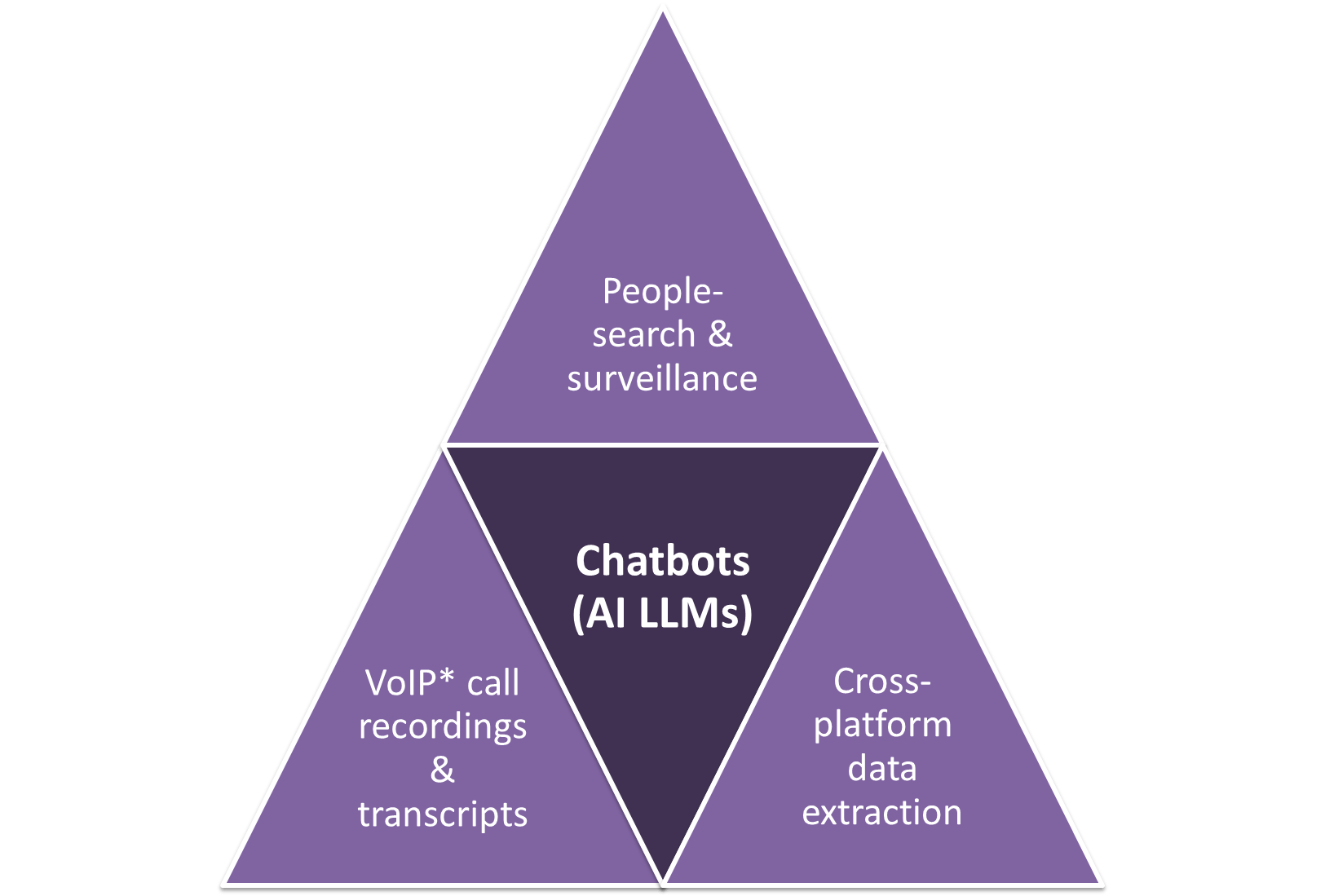
Tool stacking happens when ordinary consumer technologies are layered together until they stop functioning as separate tools and begin operating as a larger system of control: recording, transcribing, searching, storing, and interpreting one person’s life through another person’s framing.
VoIP recordings, transcripts, chatbots, people-search tools, shared accounts, metadata, screenshots, and archived messages may each look ordinary alone. The pattern appears in accumulation.
Narrative lock-in happens when an abuser takes control of the story so thoroughly that friends, family, and professionals begin interpreting the survivor through the abuser’s version of reality. The survivor is cast as unstable, difficult, dishonest, or unwell before she has even had a chance to speak in her own voice.
Narrative control existed long before AI. What AI changes is the speed, polish, and false neutrality with which one person’s version of reality can be manufactured. The abuser is no longer only telling a story. He can generate it, format it, analyze it, and “support” it with language that sounds independent of him.

Pattern Fluency
I’m not asking professionals to become technologists. I am asking them to become more fluent in patterns.
Repeated AI “analysis” of a partner’s tone, motive, intent, or psychology should not be treated as neutral curiosity. Interrogations shaped by chatbot output may sound conversational at first, but the structure has often been built before the conversation begins. Coerced statements may later appear as evidence. Fragmented records may look confusing because the context that produced them has been stripped away.
So do not ask only whether AI was present. Ask what function it served.
Was it being used to clarify, or to corner?
To reflect, or to accuse?
To support agency, or to replace it?
To document reality, or to manufacture one?
And when a survivor sounds fragmented, hesitant, contradictory, or overwhelmed, do not assume the record is weak. Ask whether the record was created inside fear.
Public Safety, Not Private Drama
This is not only private pain. For a long time, coercive control has been treated like private relationship dysfunction instead of a public safety issue. The research, and the lived outcomes, say otherwise.
Researcher and author Manya Wakefield has described coercive control as “a consistent precursor to intimate partner homicide. It appears in the background of familicide. It is the scaffolding on which mass violence is frequently constructed, particularly when a perpetrator — facing the loss of control over a primary target through separation, divorce, or custody proceedings — decides to extend the harm outward.” 1
Her work tracks how governments around the world are beginning to name coercive control in law, even as implementation remains uneven. That matters because naming the pattern is only the first step. Professionals still have to learn how to see it when it does not arrive in familiar form.
AI-enabled coercive control can look deceptively quiet from the outside. But underneath, it may be doing the same old work: isolating the survivor, controlling the narrative, escalating certainty, and preparing everyone around the abuser to misunderstand the person being harmed.
This is why the workshop asks professionals to look for infrastructure, not just incidents. The work is not only to ask what happened. It is to understand what made the harm possible.
A Request for Literacy
This work is not anti-AI but rather a request for literacy. It is not an argument that every chatbot interaction is dangerous, or that every use of technology in a relationship is abuse. It is not a request for panic.
It is anti-unexamined authority.
That distinction matters because the same tool that was used to distort my reality has also helped me explain it. The difference is not the tool alone - the difference is agency, consent, context, and control.
Professionals today are asked to recognize 2026 abuse with assumptions built for 1996 incidents. Most domestic violence training currently includes familiar forms of technology misuse such as stalking, account access, or GPS tracking, but AI-facilitated coercion is still not part of baseline literacy.
That mismatch does not appear only in courtrooms. It appears anywhere support systems are built around assumptions that do not fit the survivor in front of them. In some cases, coercive control has prolonged the amount of time a survivor remained inside the pattern, which means logistical entanglement may be deeper by the time separation occurs.
Some survivors need housing. Some need legal protection. Others need income continuity, technology access, business stability, privacy, transportation, or a way to keep a teenager’s life from collapsing alongside their own.
The point is not that one survivor’s needs are more complex than another’s. The point is that systems fail when they mistake unfamiliar needs for irrelevant ones.
All of these factors may require repeated explanation at the exact moment capacity is lowest. Without a shared vocabulary, the material can look messy instead of meaningful.
Sometimes the evidence itself is not weak. It is simply arriving in a language that our systems were never trained to read. And often, the survivor becomes the translator of harm at the exact moment she has the least spare capacity to do it.
If my story can become language, and that language can become training, and that training can help one professional recognize a pattern sooner, then this year has not only been about healing. It has been construction.
I want this workshop to help correct the burden placed on survivors to educate professionals during crisis. Institutions must become literate as abuse evolves.
One Year
There is a version of transformation that gets marketed as pretty. A caterpillar disappears, a butterfly emerges, and everyone admires the wings.
But that is not what metamorphosis is. It is dissolution. It is the body becoming unrecognizable to itself. It is a living thing breaking down into something that does not yet know how to fly.
That feels much closer to the truth.
A year ago, I did not feel like a butterfly. I did not even feel like a caterpillar. I felt like something reduced to survival instinct, something trying to stay alive in the darkness that wrapped around me like a damp blanket.
I will not romanticize what happened by calling it a cocoon. But I do understand now that transformation was happening in the dark, even when I could not see it. I feel different now - changed, and more like a butterfly than the caterpillar, yes, but not because the process was delicate.
Because it required nearly everything of me.
Today, Right Now
At this time last year, I had only just escaped the version of me someone else had built… a version built through fear, reinforced through prompts, and repeated back to me as analysis until I started to believe it - and so did our family and friends.
I did not escape it all at once.
I crawled out of it, sat with my wounds, and learned how to breathe again.
Then I wrote through it, purging the pain and letting it spill onto the page.
Then I named it, giving language to what had been hidden in confusion.
Then I built a workshop from the wreckage, not to relive what happened, but to teach others how to recognize it from the inside.
So yes, I do feel more like a butterfly than the caterpillar. But not because the story became pretty - it is still an ongoing saga of tribulations, nonetheless.
It is because I survived the part no one claps for: the dark, dissolving, unrecognizable place where transformation actually happens.
And now I am not asking to be interpreted.
I am speaking for myself.
REFERENCE
1. Wakefield, Manya. (2020). The Global Coercive Control Legislation Index. Narcissistic Abuse Rehab. Updated April 2026. Retrieved from https://www.narcissisticabuserehab.com/coercive-control-legislation-index/
Jess, the framing you've built here — AI-facilitated control as the same old work in a quieter form — is exactly right + it is exactly what professionals are missing. The pattern is recognizable once you know what you're looking at.
The problem is that most of the people in the rooms where it matters — family courts, police stations, advocacy organizations — are still looking for the familiar form. Raised voices. Visible injuries. A single dramatic incident.
What you're describing is a regime of control that is harder to trace + generates no police reports. It just produces a new dimension of the invisible prison that’s harmed so many survivors.
Thank you for putting this on the record and giving survivors of this type of abuse the language to tell this story. This is the work that creates more discerning professionals.