
Look for the Helpers
Coercive Control is a Patriarchal Symptom

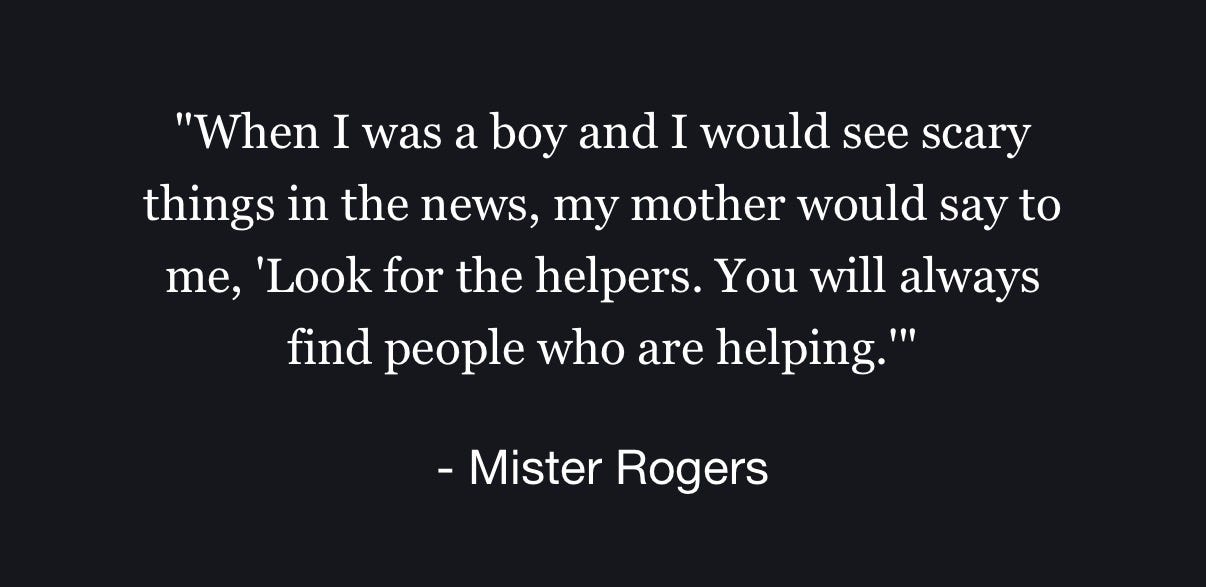
This morning, I read a quote by the late great Mr Rogers, posted in remembrance of this being the anniversary of his passing in 2003 (Feb. 27th.)
I was reminded of the true meaning of the word “helper” as defined by the Hebrew word translated “helper” in Genesis 2: ezer (עֵזֶר).
Ezer appears 21 times in the Hebrew Bible, most often referring to God as strength, shield, and deliverer. When woman is described as ezer kenegdo - a helper corresponding to man - the language is structural. It places her as strength, beside and aligned, facing man in balance.
“Our soul waits for the Lord; He is our help and our shield.” — Psalm 33:20
“My help comes from the Lord, who made heaven and earth.” — Psalm 121:2
“It is not good that the man should be alone; I will make him a helper fit for him.” — Genesis 2:18
What makes this linguistically significant is the same noun used repeatedly for God’s rescuing intervention is also the noun used for woman. Nowhere in the Hebrew Bible is man described with this word in comparable alignment with God.
Men are not called ezer. Women are.
This is not an argument about whether God is male or female. Scripture consistently uses masculine grammar for God while simultaneously affirming that God transcends human categories. He is not a man or a woman in biological terms. He is the source of all being, of men, women, and the entire created order.
“In Him we live and move and have our being.” — Acts 17:28
The point is linguistic: the verbal alignment of ezer links divine strength and feminine presence in a way that is structurally meaningful.
Before roles are ever discussed, Genesis 1 establishes that male and female are created in the image of God.
“So God created man in His own image… male and female He created them.” — Genesis 1:27
The word ezer reinforces the equilibrium, describing necessary strength, not ornamental support.
But history has not treated it that way. Patriarchal interpretations of Scripture have repeatedly reduced that word into subservience. The language of strength has been softened into silence. The theology of partnership has been reshaped into hierarchy.
Power, once distorted, seeks reinforcement - and distorted theology becomes a convenient tool for an abuser.
I lived inside that distortion for many years but where it really began is unclear. What is fully now understood is that I have been married to a man (hopefully soon to be divorced) who clearly hates women and believes them to be beneath him. He uses religion as the foundation for his contempt.
Scripture became a weapon to justify his control, my humiliation, and the coercion that kept me shackled. That is not faith. It is domination parading as a biblical martyr.
Coercive control is always about power untethered from accountability. It mirrors the same imbalance we see at a societal scale: dominance rewarded, aggression normalized, authority equated with entitlement. We are seeing this unfold in real time due to the release of those files centered on a man who orchestrated so much pain. I won’t spell out his name here - his legacy must be silenced.
My upbringing was not traditional in many ways, and one of those was that my parents declared themselves as believers in the Bahá’í Faith before I was born. I was raised up through a religion that explicitly affirms the equality of women and men as foundational to human progress. Humanity is described as a bird with two wings - one male, one female. Until both wings are equally strong, the bird cannot fly.
The Faith goes further to explain that lasting peace is inseparable from the need for equality of women and men. A world in which women share full authority would not send its children to die in wars that could be resolved through education, consultation, and communication.
“Women and men have been and will always be equal in the sight of God.” — Bahá’u’lláh
“As long as women are prevented from attaining their highest possibilities, so long will men be unable to achieve the greatness which might be theirs.” — ‘Abdu’l-Bahá
“When women participate fully and equally in the affairs of the world… war will cease.” — ‘Abdu’l-Bahá
This is structural insight. When half of humanity is suppressed, the whole system destabilizes. When strength beside is recast as weakness beneath, imbalance becomes the norm - in homes, in governments, and certainly in global conflict.
A matriarchal foundation restores balance. It honors the strength embedded in ezer. It recognizes that partnership is the original design and coercion is the corruption. Matriarchy is a structural equilibrium, not female supremacy. It is a rebuilt order where power is shared, not weaponized.
When Mr. Rogers quoted his mother, he was pointing us toward ancient knowledge. He understood something a patriarchal mind often forgets: that strength is proven in how it protects the vulnerable. He embedded that lesson into generations of children, insisting that our youngest citizens deserve gentleness and dignity. That instinct - to shield rather than control - reflects the true meaning of ezer.
“Blessed are the peacemakers, for they shall be called sons of God.” — Matthew 5:9
Scripture quotations from the ESV via BibleGateway.
Bahá’í quotations from the official Bahá’í Reference Library (bahai.org).
Endnotes
Psalm 33:20 (ESV), BibleGateway.
https://www.biblegateway.com/passage/?search=Psalm+33%3A20&version=ESVPsalm 121:1–2 (ESV), BibleGateway.
https://www.biblegateway.com/passage/?search=Psalm+121%3A1-2&version=ESVGenesis 2:18 (ESV), BibleGateway.
https://www.biblegateway.com/passage/?search=Genesis+2%3A18&version=ESVActs 17:28 (ESV), BibleGateway.
https://www.biblegateway.com/passage/?search=Acts+17%3A28&version=ESVGenesis 1:27 (ESV), BibleGateway.
https://www.biblegateway.com/passage/?search=Genesis+1%3A27&version=ESVMatthew 5:9 (ESV), BibleGateway.
https://www.biblegateway.com/passage/?search=Matthew+5%3A9&version=ESVBahá’u’lláh, statements on equality of women and men, Women (Compilation), Bahá’í Reference Library.
https://www.bahai.org/library/authoritative-texts/compilations/women/women.pdf‘Abdu’l-Bahá, “The world of humanity has two wings…,” Selections from the Writings of ‘Abdu’l-Bahá, Bahá’í Reference Library.
https://www.bahai.org/library/authoritative-texts/abdul-baha/selections-writings-abdul-baha/‘Abdu’l-Bahá, statements linking equality and peace, The Promulgation of Universal Peace, Bahá’í Reference Library.
https://www.bahai.org/library/authoritative-texts/abdul-baha/promulgation-universal-peace/
love that . . . look for the helpers