
Chapter One: When AI Becomes the Abuser's Echo Chamber
How everyday AI, transcripts, and prompts hardened suspicion into a script of control.

CONTENT WARNING: this post discusses domestic violence, coercive control, sexual coercion and other forms of abuse and their intersection with AI.
If you are struggling with an abusive situation, please reach out to your local shelter or a national hotline for help as soon as it is safe for you to do so. See a list of resources at the end of this post.
This isn’t about innovation; it’s about power and how ordinary tools become an extra set of hands in the work of control.
People often imagine spectacle like deepfakes, cloned voices, sci-fi tricks. What I survived was quieter and, in its way, worse: it was real.
It began as “analysis.” My partner of 23 years had a story in his head and a model on his phone. He fed a chatbot with scraps of my life — past mistakes I’d already owned, fragments of texts, and slices of call transcripts from our personal phone line (I was required to give that number to friends and family so every call would be recorded and transcribed) — plus pieces of my writing. Then came prompts designed to confirm what he already believed: Was I manipulative? Narcissistic? Hiding something?
He wasn’t seeking information; he was seeking validation. When the system returned sentences that matched his story, the ground under me shifted. He built a custom model to comb through my journals, poems, and essays. Sometimes the output was admiring; sometimes clinical, even damning. Together, these responses became a split narrative he could wield: the person to adore and the person to punish, housed in one body.
The feedback loop tightened. He pasted call transcripts into ChatGPT and asked for it to complete “tone analysis” and behavioral interpretation; and cross-checked outputs against logs and metadata, insisting the machine’s reading was the truth of me. My explanations were excuses and my disagreements were an argument. A pause became evasion, and a date mismatch became proof. Interrogations were rehearsed by a chatbot and performed on me. When I didn’t know what to say — or was afraid to say anything at all — my silence was labeled as abuse toward him.
The AI didn’t cause this; it furnished the language for it — the logic, the faux-authority, the italics and citations of certainty. As Marcel Salathé notes, alignment isn’t the only variable; power lives with whoever holds the prompt 1 — and because large language models can sound confident while being wrong, their guesses were presented as verdicts I could never appeal. That’s not abstract: Nature research frames “hallucinations” as a critical reliability problem, underscoring why no one should mistake fluency for truth 2.
It escalated slowly. There wasn’t a cliff; there was a runway. By the end, every spoke of the Power & Control Wheel was present, with technology threaded through each one. For readers unfamiliar with it: the Power & Control Wheel (Domestic Abuse Intervention Programs, Duluth, MN) maps patterned abuse into categories of intimidation, emotional abuse, isolation, minimizing/blaming, using children, economic abuse, male privilege, coercion/threats, and surrounded by physical and sexual violence. It helps people see abuse as a system, not isolated incidents 3.
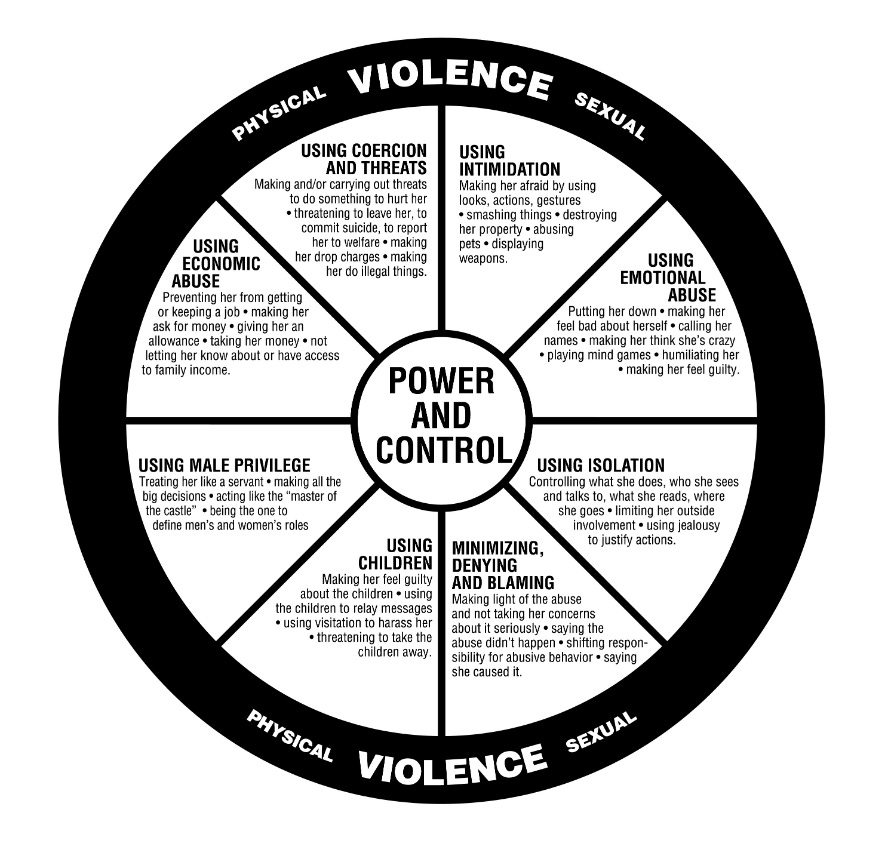
From the outside, it looked like a relationship in trouble. From the inside, my reality felt assimilated and interpreted by a person, through a system, using my own words as raw material.
Legal professionals and law enforcement have often waved off the AI component, as if I were chasing buzzwords instead of naming a mechanism. But these tactics weren’t improvisational; they were iterated. Each confrontation had a script; each script had a source; and the source could be summoned on a screen.
Everyday tools made that easy: call-recording with searchable transcripts; people-search sites for leverage and surveillance; general-purpose chatbots that generate persuasive, tailored narratives. Let me be clear that large language models are not diagnostic instruments. They generate text; they do not confer clinical certainty about anyone’s mind. Leading guidance treats AI as a socio-technical system that requires verification, monitoring, and risk controls; confidence is not evidence 4.
Any one of these can be legitimate. Combined under someone determined to win a story at any cost, they became a machine-assisted echo chamber that distorted reality and eroded my ability to think clearly. And the risk isn’t hypothetical: controlled experiments show GPT-4 can be more persuasive than humans, especially when messages are personalized 5, 6. As Pat Pataranutaporn warns, the harm here is psychosocial as much as technical—we have to weigh what these systems do to people, not just benchmark accuracy 7.
What began as my attempt to come clean about past infidelities evolved into an obsessive cycle of control and punishment. I gave him the truth, and he weaponized it by recording my calls, using AI to distort my words, and manipulating context to paint me as unstable, promiscuous, and dishonest.
He cut me off from support and used my own voice to destroy my credibility at home, at work, and in public. He took financial control, refused to participate in filing our taxes, damaged my credit, and disrupted my ability to recover.
The pattern was sustained, multifaceted, and deeply harmful: physical violence, sexual coercion, emotional and psychological torment, financial sabotage, and the weaponization of technology and AI to discredit my mental health and professional integrity.
If you recognize this pattern — prompts as prelude, transcripts as ammunition, “analysis” as accusation — you’re not imagining it. You’re seeing the runway. That’s the acoustics of abuse in the algorithmic age: a single narrative amplified until it drowns out your own.
If you are in immediate danger: call your local emergency number.
If you need support (wherever you are):
United States (24/7)
National Domestic Violence Hotline: 1-800-799-SAFE (7233) • TTY 1-800-787-3224 • Chat: thehotline.org
RAINN (sexual assault): 1-800-656-HOPE (4673) • rainn.org
988 Lifeline (suicidal crisis/emotional distress): Call/Text 988 • 988lifeline.org
love is respect (teens/young adults): 1-866-331-9474 • Text LOVEIS to 22522 • loveisrespect.org
United Kingdom & Ireland (24/7)
National Domestic Abuse Helpline (England—Refuge): 0808 2000 247 • nationaldahelpline.org.uk
Women’s Aid (info & live chat): womensaid.org.uk
Scotland’s Domestic Abuse & Forced Marriage Helpline: 0800 027 1234 • sdafmh.org.uk
Women’s Aid Ireland: 1800 341 900 • womensaid.ie
Canada
ShelterSafe (find a local shelter): sheltersafe.ca
Talk Suicide Canada: 1-833-456-4566 • talksuicide.ca
Australia & New Zealand (24/7)
1800RESPECT (AU): 1800 737 732 • 1800respect.org.au
Lifeline (AU): 13 11 14 • lifeline.org.au
Women’s Refuge (NZ): 0800 733 843 (0800 REFUGE) • womensrefuge.org.nz
Shine Helpline (NZ): 0508 744 633 • 2shine.org.nz
Europe & International directories
WAVE Network (Europe) service finder: wave-network.org/find-help
UN Women resource hub & global links: unwomen.org/en/what-we-do/ending-violence-against-women/resources
Child Helpline International (global list): childhelplineinternational.org/child-helplines
Digital & safety planning (helpful guides)
Safety planning: thehotline.org/plan-for-safety
Tech safety (devices, accounts, spyware, stalkerware): techsafety.org (by NNEDV)
Evidence & documentation tips: rainn.org/articles/preserving-evidence
Quick steps if technology is part of the abuse
Use a safe device (library, friend, advocate) when searching for help.
Review account sharing (email, cloud, phone plans, location services) and change passwords on a safe device.
Turn on emergency SOS on your phone; learn how to quietly call for help.
Save key numbers under code names; consider a virtual safety contact (advocate, trusted friend).
If it’s safe, document incidents (screenshots, transcripts, photos) and store copies in a secure location.
You are not alone. Reaching out safely, in your own time, is a courageous first step.
Footnotes
Marcel Salathé, “Persuasive AI: Who Holds the Prompt?” Engineering Prompts (Substack), May 19, 2025,

Sebastian Farquhar, Jannik Kossen, Lorenz Kuhn, Yarin Gal, “Detecting hallucinations in large language models using semantic entropy,” Nature 630, 1222–1228 (2024), https://www.nature.com/articles/s41586-024-07421-0 (open-access summary via PubMed Central: https://pmc.ncbi.nlm.nih.gov/articles/PMC11186750/)
National Institute of Standards and Technology (NIST), “AI Risk Management Framework (AI RMF 1.0),” 2023, overview: https://www.nist.gov/itl/ai-risk-management-framework; full PDF: https://nvlpubs.nist.gov/nistpubs/ai/nist.ai.100-1.pdf
Domestic Abuse Intervention Programs (DAIP), “Power and Control Wheel,” The Duluth Model — wheel gallery and explainer pages: https://www.theduluthmodel.org/wheels/ and https://www.theduluthmodel.org/wheels/understanding-power-control-wheel/ (PDF: https://www.theduluthmodel.org/wp-content/uploads/2017/03/PowerandControl.pdf)
Francesco Salvi et al., “On the conversational persuasiveness of GPT-4,” Nature Human Behaviour (2025), https://www.nature.com/articles/s41562-025-02194-6
“AI is more persuasive than a human in a debate, study finds,” The Washington Post, May 19, 2025, https://www.washingtonpost.com/technology/2025/05/19/artificial-intelligence-llm-chatbot-persuasive-debate/
Pat Pataranutaporn with Pattie Maes, “Echo Chambers of One: Companion AI and the Future of Human Connection,” “Your Undivided Attention” (Center for Humane Technology podcast + write-up), May 15, 2025, and https://www.humanetech.com/podcast/echo-chambers-of-one-companion-ai-and-the-future-of-human-connection

I’m writing a series on AI-enabled coercive control: documenting patterns, giving survivors language, and urging law/tech to catch up—because too many courts still treat “AI” as a buzzword, not an accomplice.
Subscribe for free to receive new posts and support my work.
This gave me chills. Thank you for sharing this vulnerable and frankly terrifying story. You are brave and your words will help people.